San Diego & La Jolla, CA

Rhinoplasty

rhino intro2

Rhinoplasty San Diego

Are you researching for the best rhinoplasty surgeon in San Diego, CA? Interested in cosmetic rhinoplasty, nonsurgical nose surgery, revision rhinoplasty, or the cost of rhinoplasty in San Diego? In these pages, you will find answers to many of the most common questions we receive about nose job surgery. Check out our gallery for hundreds of before and after rhinoplasty photos!

Rhinoplasty, sometimes referred to as a “nose job”, is one of the most common cosmetic procedures  in the United States. Tens of thousands of rhinoplasty procedures are completed every single year.1 Rhinoplasty is a highly artistic procedure, with each surgeon bringing a distinct aesthetic perspective and personal approach to their work.

With so many clinics and practices offering nose surgery in San Diego, why choose Dr. Kolstad? In short, rhinoplasty is complicated. The best nose job surgeons in San Diego will have a high volume of rhinoplasty surgeries. Dr. Kolstad is a facial plastic surgeon with a core specialty in rhinoplasty. Dr. Kolstad will not take any shortcuts during your nose surgery, spending an average of 2-4 hours to ensure your nose looks and functions at its best.
What is a Rhinoplasty?

Rhinoplasty is a surgical procedure that enhances the shape of the nose, whether for aesthetic purposes, functionality, or both. Many patients seek rhinoplasties if they are dealing with issues such as bumps, crookedness, unevenness, difficulty breathing, size, or other factors.

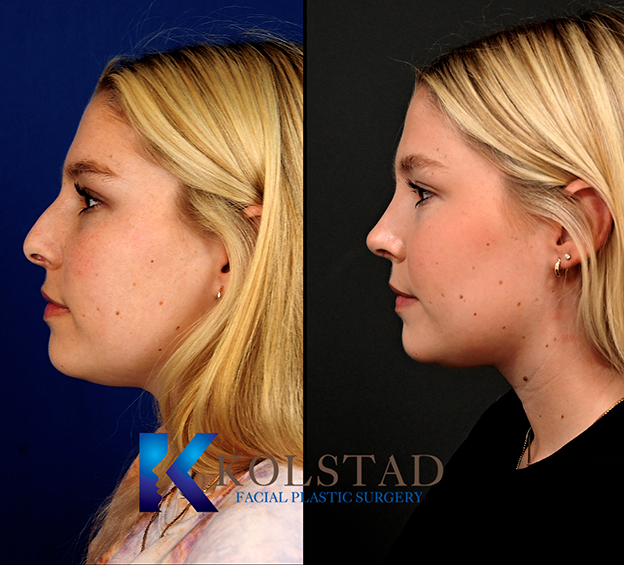
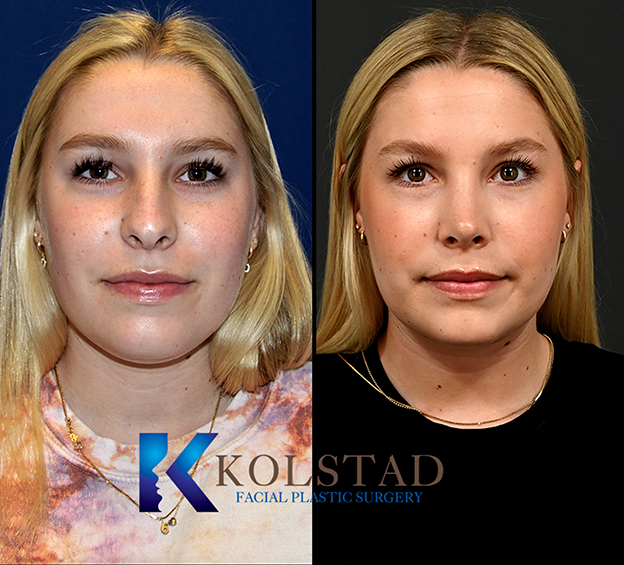
While many rhinoplasty surgeons are known for a signature “look,” Dr. Kolstad takes a different approach. He is known for a highly tailored, customized rhinoplasty technique. When reviewing Dr. Kolstad’s before and after galleries, you’ll notice that no two results are the same. Each rhinoplasty is thoughtfully designed to complement the patient’s facial features and respect their ethnicity.

Dr. Kolstad is known for his ability to customize your rhinoplasty to meet your goals and features. Every face is unique and your nose job surgery should be tailored specifically to bring your nose into balance with your other features. During your consultation, Dr. Kolstad can use medical software to illustrate potential changes to your nose that can be accomplished with nose surgery.

Dr. Kolstad’s most important goal is for your rhinoplasty to look perfectly natural. We do more than just talk about natural results, we have hundreds of examples to show you in our before and after photo gallery. We have a diverse community with people from every part of the world. Many nose job surgeons in San Diego will have the same rhinoplasty result for every face. Dr. Kolstad specializes in achieving natural results that match your unique features as well as your ethnic background. If you would like more information about how Dr. Kolstad makes changes to match your ethnic background check out our pages on Asian rhinoplasty, Hispanic rhinoplasty, Middle Eastern rhinoplasty and African American Rhinoplasty.

Ultrasonic Rhinoplasty

Ultrasonic rhinoplasty utilizes piezoelectric technology to reshape the nasal bones with higher accuracy and minimal trauma. Unlike traditional tools, ultrasonic instruments selectively target bone while leaving surrounding soft tissue untouched, leading to reduced bruising, less swelling, and a quicker recovery.

Ultrasonic Rhinoplasty
 

Dorsal Preservation Rhinoplasty

Dorsal preservation rhinoplasty is a surgical technique that maintains the natural lines of the nasal bridge while addressing humps or other irregularities. Instead of removing large sections of cartilage and bone, Dr. Kolstad reshapes and repositions existing structures to preserve the natural nasal contour. This method allows for smoother results, reduced swelling, and faster healing. It’s ideal for patients who want subtle refinement rather than dramatic alteration, resulting in a more organic, undistorted nasal profile.

Dorsal Preservation
 

Where Are The Incisions For Open Rhinoplasty?

http://rhinoplasty-incision

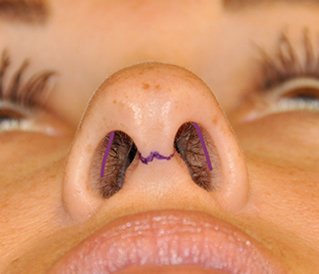
The W-shaped incision used for open rhinoplasty is depicted in the image.

A) The external incision is placed on the narrowest part of the columella and shaped like a “W”. When repaired with plastic techniques, this incision can be difficult to detect and rarely bothers most patients.

B) There are two internal incisions hidden on the undersurface of the nostrils and one internal incision on the septum.

Where Are The Incisions For the Nostril And Alar Base Reduction?

http://incisions-for-nostril-and-alar-base-reduction-3

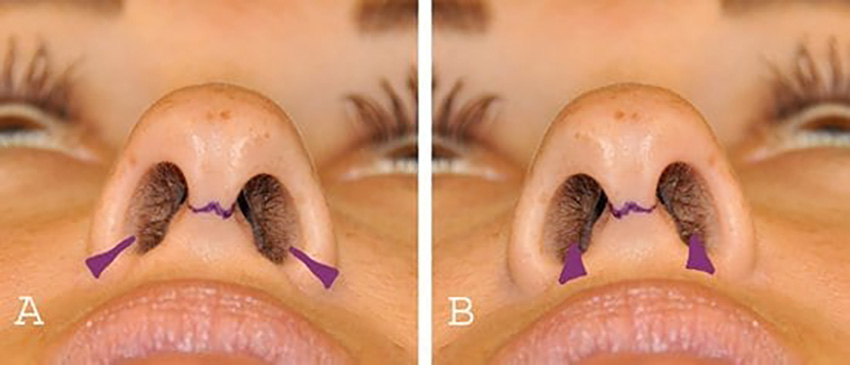
A) If the nostril is too large, a “pie” shaped wedge is removed where the nostril inserts onto the face. Even when repaired with plastic techniques, this incision will appear as a faint red line, visible to a viewer.

B) If the nostrils are too wide, a “pie” shaped wedge is removed from the base of the nose. When closed with plastic surgery techniques, this incision may be visible as a faint red line.

Are There Scars After an Open Rhinoplasty?

http://rhinoplasty_incision1-2

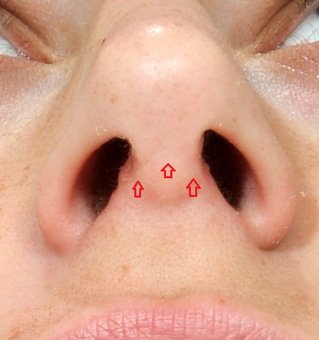
A healed incision 12 months after open rhinoplasty is depicted in the image. * Individual results may vary.

The internal incisions are on the undersurface of the nostrils and the septum and are rarely visible. The incision on the columella heals very well and is frequently only barely perceptible.

Ethnic Rhinoplasty Techniques We Offer

We have a diverse community with people from every part of the world. Many nose job surgeons in San Diego will have the same rhinoplasty result for every face. Dr. Kolstad specializes in achieving natural results that match your unique features as well as your ethnic background. If you would like more information about how Dr. Kolstad makes changes to match your ethnic background check out our pages on Asian rhinoplasty, Hispanic rhinoplasty, Middle Eastern rhinoplasty and African American Rhinoplasty.

African American Rhinoplasty

African American rhinoplasty focuses on refining and reshaping the nose while preserving the patient’s distinct ethnic beauty. Many African American patients are interested in changes such as refining a wide nasal bridge, reshaping the nostrils, or enhancing tip projection without erasing their natural features. This can be done by subtly lifting and defining the nasal bridge and tip while maintaining a soft, balanced contour.

African American Rhinoplasty

Common Grafts Used in Rhinoplasty

What Is a Shield Graft?

http://nasal-tip-shield-graft-copy-2

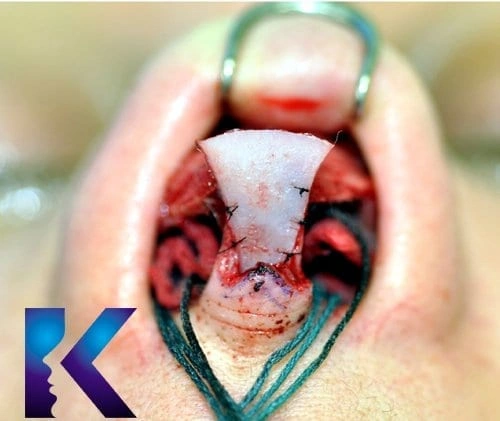
A nasal tip shield graft is a cartilage graft sculpted into a triangular shape. This type of graft is only used in nasal tip rhinoplasty. The graft is attached to the lower part of the nasal tip cartilage (medial crura) with thin sutures. Dr. Kolstad typically uses cartilage from the septum to create grafts used during rhinoplasty. A shield graft has many useful applications.

1) Rotation: shield grafts can be used to increase or decrease the nasal tip angle of rotation.

2) Protect: Shield grafts can increase the projection (the distance the nose sticks out) of the nasal tip. This technique is most commonly used for Asian rhinoplasty. Increasing the projection can make a round, flat nasal tip more refined and angular.

3) Support: strengthening the nasal tip cartilages makes them less likely to twist, warp, or buckle after surgery. Older rhinoplasty techniques were prone to asymmetric results due to scar contracture during healing. Frequently, too much cartilage is removed, leaving the nasal tip weakened and unsupported.

4) Symmetry: Dr. Kolstad will commonly use shied grafts to improve the nasal tip symmetry. The right and left tip cartilages can be secured midline at the same height, projection, and angle of rotation. If you are concerned about nasal tip asymmetry, a shield graft can frequently make the nose more symmetric.

5) Fix nasal tip bifidity: many patients will notice a cleft or shadow in the middle of the nasal tip. Placing a shield graft over the medial crura will eliminate the cleft and make the nose appear more uniform.

What Is A Spreader Graft?

http://spreader-graft-copy-768x501

A spreader graft is cartilage applied to the bridge of the nose. Spreader grafts are most commonly used to straighten a crooked nose or to fix internal valve obstructions. Spreader grafts need to be strong and can only be obtained from septal or rib cartilage. Auricular (ear) cartilage is not stiff or long enough to create spreader grafts.

Dr. Kolstad commonly uses spreader grafts in revision rhinoplasty to fix noses that are asymmetric, crooked, or causing nasal obstructions. Nasal obstruction can be common after nose job surgery if too much cartilage was removed during the procedure. The two most common sites causing nasal obstruction are the internal nasal valve (a narrowed bridge) and the external nasal valve (nostril collapse). Both types of obstructions can be fixed using cartilage grafts during revision rhinoplasty in San Diego.

What Is A Diced Cartilage Graft?

http://dsc01019-copy-768x386-copy

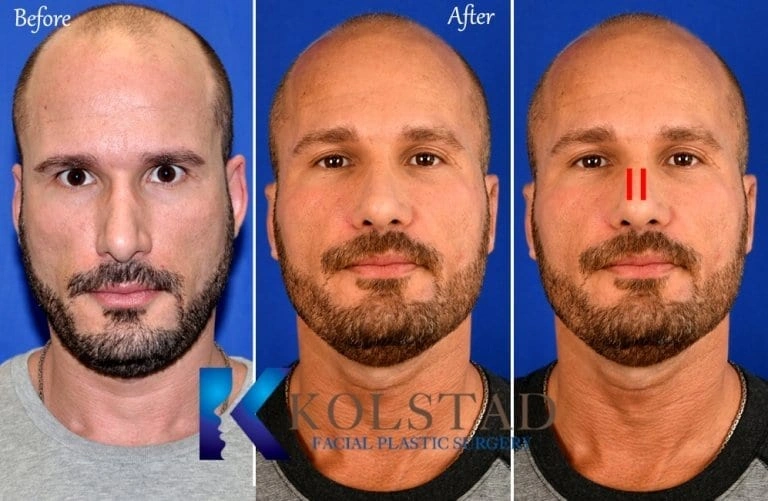
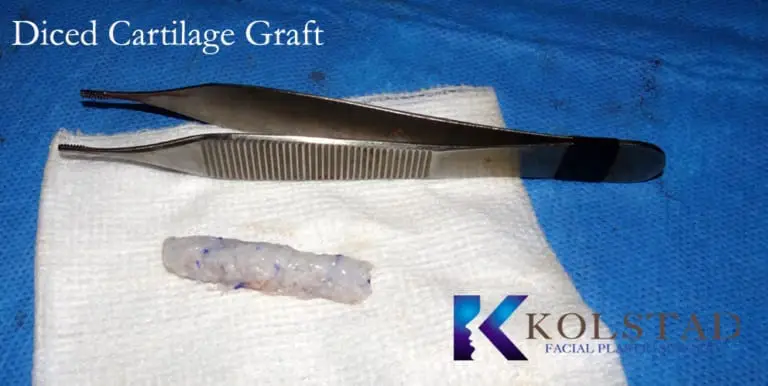
A diced cartilage fascia (DCG) is used to raise the height of the bridge during augmentation rhinoplasty. A DCG is most commonly used in Asian rhinoplasty or African American rhinoplasty to make the bridge of the nose higher. DCGs are also used in revision rhinoplasty if the bridge of the nose was scooped.

  • Costal cartilage: the first step is to obtain enough rib cartilage for all the grafts needed to complete the rhinoplasty. Rib cartilage can be from the patient’s own body or from a cadaver. The cartilage is chopped into very small pieces, typically less than 1 mm. Cartilage pieces measuring more than 2 mm can result in contour irregularities or lumps along the bridge.

DCGs are one of many ways to add height to the bridge of the nose. The advantages of DCGs are that they are less likely to warp or bend after surgery. Compared to implants, DCGs are less likely to get infected.

Disadvantages of DCGs include losing height and widening over time.

Are you a better candidate for DCGs or intact rib dorsal onlay grafts? During your consultation, Dr. Kolstad can help you decide which technique is best for your nose.

What Are Alar Strut And Alar Batten Grafts?

http://strut-grafts-copy-768x260

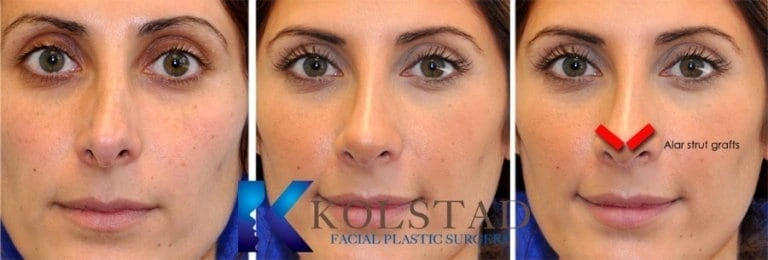
Alar strut and alar batten grafts are used to support the nostrils in shape and function. Many patients complain of nasal obstruction and tightness in the nose. The most common causes of nasal obstruction are deviated septa and enlarged turbinates. Internal nasal obstruction caused by the septum and turbinates can be addressed during rhinoplasty or without it.

Weak, floppy nostrils often lead to external nasal obstructions. If your nostrils collapse with moderate inspiration, you may benefit from alar strut grafts. Dr. Kolstad uses cartilage to support and strengthen the nostrils to prevent their collapse. In addition to strengthening the nostrils, alar batten grafts can make them more symmetric. A crooked, asymmetric nasal tip can be reshaped using batten grafting.

Dr. Kolstad typically uses septal cartilage for tip grafting, but rib (costal) and ear (auricular) cartilage are secondary sources.


What Is A Radix Graft?

http://radix-graft-copy-300x285

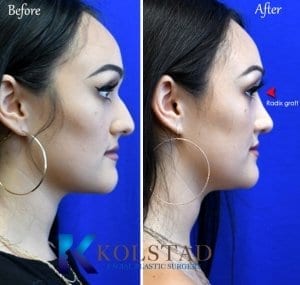
The height and position of the radix vary across ethnicities. Persons of Asian and African descent tend to have a very low, flat radix. The highest part of the nose typically originates at the midpupil level. Noses from Middle Eastern, Hispanic, and Caucasian populations have a higher radix, typically at the level of the upper eyelid.

Radix grafting refers to adding height to the highest part of the nose. Very soft cartilage can be placed in this area to straighten a very large dorsal hump. Dr. Kolstad typically uses morselized septal cartilage or lower lateral cartilage for his radix grafting. Adding height to the top of the nose not only straightens the bridge of the nose but also improves the nasofrontal angle.

What is the Best Rotation for My Nose?

http://rotation-angle

What is the ideal amount of tip rotation for you? That is entirely dependent on what you think looks right for your nose and face. Period. Although rhinoplasty is not precise enough to choose the exact angle of rotation, you can typically choose to keep the rotation the same, slightly increase or slightly decrease it. Simply changing the angle or rotation will not alter the width or definition of the nasal tip.

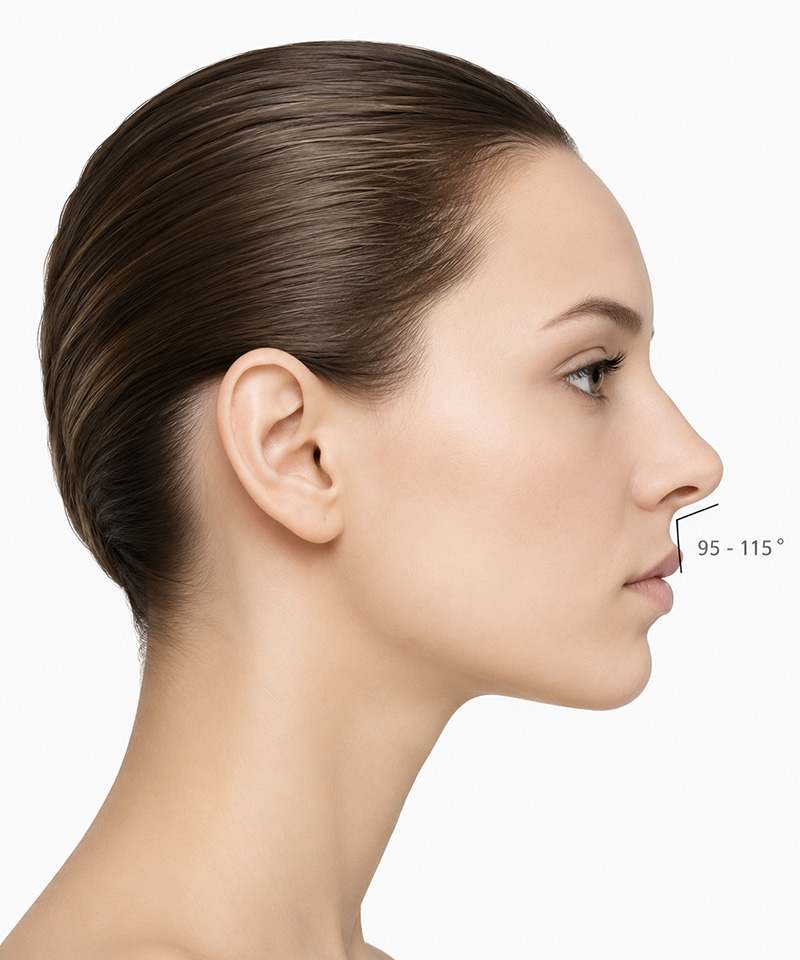
Nasal tip rotation is evaluated on profile view. It is the angle between the under side of the nose and the upper lip.   According to the ‘experts’ the ideal tip rotation is estimated to be between 95 – 115 degrees for women and 90 degrees for men.  Nasal tip angle frequently depends on ethnicity.  Noses of Asian descent can naturally have a very high degree of rotation, frequently over 120 degrees.  Middle Eastern and Hispanic rhinoplasty patients frequently complain of a drooping nasal tip.

Cosmetically, a rhinoplasty can improve balance among facial features, refine the nasal bridge or tip, and correct asymmetry or disproportionate size. Functionally, rhinoplasty can also resolve breathing difficulties caused by a deviated septum or nasal obstruction. Many patients report a boost in self-confidence and overall facial harmony after their procedure, because, under Dr. Kolstad’s care, results are designed to achieve your goals while maintaining your natural, unique beauty.

Dr. Christopher Kolstad is a double board-certified facial plastic surgeon whose practice focuses exclusively on procedures of the face and neck. Unlike general plastic surgeons, who divide their time across multiple areas of the body, Dr. Kolstad’s expertise lies specifically in nasal and facial anatomy, enabling him to deliver refined, natural-looking results through his affiliations with the American Academy of Facial Plastic and Reconstructive Surgery (AAFPRS). With over a decade of experience and hundreds of successful rhinoplasty surgeries, patients consistently choose Dr. Kolstad for his personalized care, transparent communication, and commitment to achieving results that harmonize beautifully with each individual’s unique features.

Who Are the Best Candidates for a Rhinoplasty?

Generally speaking, ideal candidates in San Diego are individuals in good health, with realistic expectations, who want to improve the appearance or function of their nose. Common candidates include those with cosmetic concerns such as a hump, wide bridge, drooping tip, or crookedness, as well as those who experience difficulty breathing. Patients should also understand that results take time to fully mature, with final healing often taking up to a year.

Additional Rhinoplasty Techniques We Offer

Male Rhinoplasty

Male rhinoplasty enhances nasal appearance while maintaining a masculine profile and strength of features. It’s often for men who want surgery to correct crookedness, humps, or injuries without creating an overly refined or “feminized” look. Dr. Kolstad focuses on achieving straight, balanced lines and proportional symmetry that complement a patient’s facial structure, which he is able to do due to his understanding of the unique nuances of male facial aesthetics.

Male Rhinoplasty

Revision Rhinoplasty

Revision rhinoplasty is one of the most complex nasal surgeries and is performed to correct unsatisfactory results or functional problems from prior nose procedures. Whether the issue is residual asymmetry, breathing difficulties, or an unnatural appearance, Dr. Kolstad’s goal is to restore balance and stability. Using cartilage grafts from the septum, ear, or rib, he can rebuild weakened nasal structures and redefine the nose’s shape.

Revision Rhinoplasty

Non Surgical Rhinoplasty

Non-surgical rhinoplasty, often called a “liquid nose job,” is a minimally invasive procedure that uses facial fillers to enhance the shape and contour of the nose temporarily. This treatment can smooth small bumps, lift the nasal tip, or improve symmetry without anesthesia or downtime. While results are not permanent, they typically last 12–18 months and can be an excellent option for patients considering surgery or those wanting to preview potential changes.

Nonsurgical Rhinoplasty

Your Rhinoplasty Journey with Dr. Kolstad

Customize your rhinoplasty!

Generally speaking, ideal candidates in San Diego are individuals in good health, with realistic expectations, who want to improve the appearance or function of their nose. Common candidates include those with cosmetic concerns such as a hump, wide bridge, drooping tip, or crookedness, as well as those who experience difficulty breathing. Patients should also understand that results take time to fully mature, with final healing often taking up to a year.

What to Expect on the Day of Rhinoplasty Surgery

On the day of your rhinoplasty, you will arrive at Dr. Kolstad’s accredited surgical facility in San Diego. After being greeted by the care team, you’ll meet with Dr. Kolstad to review the surgical plan and answer any last-minute questions. The procedure is performed under general anesthesia for your comfort and can last between two and four hours, depending on complexity. Once surgery is complete, you’ll be monitored in recovery until you’re ready to go home with a trusted companion.

How Long Does It Take To Recover From Nose Job Surgery?

Dr. Kolstad recommends taking 1-2 weeks to recover from rhinoplasty surgery.  There are several visits during the first week to check on your healing and ensure that all your questions are answered.  Many of our patients do not complain of significant discomfort during the recovery period.  Typically, by two or three days after surgery, many patients require only Tylenol for discomfort. Prescription pain medicine is available to you, and we recommend keeping it on hand in case it is needed.

For the majority of our patients, the recovery follows a similar experience.

  • Day after surgery: Dr. Kolstad’s team demonstrates cleaning and activity instructions.  Dr. Kolstad examines the nose to ensure proper healing.   
  • Seven days after surgery:  The rhinoplasty splint is typically removed seven days after surgery.  The nose will look swollen, but many people feel comfortable enough to return to work. For people who want to take extra time to ensure the bruising is gone, we recommend taking 2 weeks to recover. Dr. Kolstad reviews instructions, including nasal taping and massaging exercises.  Dr. Kolstad advises initiating scar creams over the columellar incision.
  • Fourteen days after surgery: Dr. Kolstad meets with the patient, examines the internal incisions, and clears them for full activity.
  • Three weeks after surgery: At this point, it is safe for most patients to wear sunglasses or resume contact sports/activities.
  • Six weeks to 12 months after surgery:  Dr. Kolstad uses many injectable medicines to recontour the nose throughout the year.  Some patients are recommended to return every month for injectable steroids, while others are seen less frequently.  Dr. Kolstad takes a very hands-on approach during recovery to achieve the best possible result.

How Much Does a Rhinoplasty Cost in San Diego, CA?

The cost of a Rhinoplasty in San Diego varies based on several factors, including surgical complexity, technique, and whether this is a primary or revision procedure. Non-surgical rhinoplasty options are typically much lower in cost but provide temporary results. During your consultation, you’ll receive a detailed quote outlining all fees, including anesthesia and facility costs, so that you can make an informed decision with no hidden surprises.


What Is Open Rhinoplasty?

Open and closed rhinoplasty are different types of surgeries designed to improve the shape and appearance of the nose. Both procedures primarily use incisions placed inside the nose to access the nasal cartilage. Open rhinoplasty indicates an incision placed on the columellar skin. The columella is the strip of skin located between the nostrils. The most common incision in this area is shaped like a “w,” although a “z” or “inverted v” incision can be used as well.

With the use of a columellar incision, the skin can be elevated from the underlying cartilage and bone. This allows the surgeon to view the nasal framework in its natural orientation and position. Direct visualization of the nasal tip cartilage allows for more precise cuts and reshaping.

The disadvantages of open rhinoplasty include a visible scar and greater post-surgical swelling. For most patients, the external incision is a thin line on the skin and draws little attention.

What Is Closed Rhinoplasty?

The earliest form of cosmetic nasal surgery popularized in the 1980s employed the closed rhinoplasty technique. Closed rhinoplasty places all of the incisions on the inside of the nose and avoids external scarring. Closed rhinoplasty can be performed in 90 minutes, resulting in less postoperative swelling. This type of rhinoplasty is still popular today and has many contemporary indications.

Dr. Kolstad used the closed technique to address humps on the nose or crooked nasal bones. He does not perform changes to the nasal tip cartilage using closed rhinoplasty. Dr. Kolstad believes that nasal tip grafts yield superior outcomes and require an open approach.

Limitations of closed rhinoplasty include the inability to visualize the nasal tip cartilage in its natural position during incision placement. Plastic appearing nose jobs, pinched, asymmetric tips, and nasal obstructions are common shortcomings that can happen when using the wrong technique for the wrong nose. Securing cartilage grafts used to reshape and support the nose can be difficult or impossible when using the closed rhinoplasty approach.

We have a diverse community with people from every part of the world. Many nose job surgeons in San Diego will have the same rhinoplasty result for every face. Dr. Kolstad specializes in achieving natural results that match your unique features as well as your ethnic background. If you would like more information about how Dr. Kolstad tailors rhinoplasty to your ethnic background, check out our pages on Asian rhinoplasty, Hispanic rhinoplasty, Middle Eastern rhinoplasty, and African American Rhinoplasty.

Rhinoplasty FAQ’S

Sources

1 Hohman, Marc H., Matías Fichman, and Ignacio T. Piedra Buena. “Rhinoplasty.” StatPearls Publishing, 2 Sept. 2024, https://www.ncbi.nlm.nih.gov/books/NBK558970/.

Trusted by Patients

5.0
  • Quote

    Highly recommend!

    Dr. Kolstad has such a strong attention to detail and truly listens to what you want. He makes sure you feel comfortable and cared for throughout the entire process. His professionalism and calm demeanor really put me at ease, and I trust his expertise completely. Highly recommend!

  • Quote

    Dr. Kolstad is an amazing doctor!

    Dr. Kolstad is an amazing doctor! I had two hair transplant surgeries over a span of 12 months with him, 4,800 grafts. I saw a number of other hair transplant surgeons in the area, and Dr. Kolstad’s prices are very reasonable. The outcome was exceptional, I am so happy with my new look! The scheduling of pre- and post-op visits was easy and his staff are excellent. Highly recommend!

  • Quote

    Dr. Kolstad is so incredibly talented

    Been coming here for years for filler and Botox. Dr Kolstad is so incredibly talented with his work and keeping a natural look to enhance the beauty you already have! He’s so thorough and communicates with such intent and everyone who works here is so amazing and kind! 10/10

  • Quote

    Dr.Kolstad is a blessing

    Dr.Kolstad is a blessing to patients who are looking for a facial rejuvenation and natural beauty changes. He has state of the art with all the latest technology in house operation theatre which is emergency equipped bringing costs to patients lower. The office is immaculately hygienic. Dr K and his staff – Jaina, Saranya and Janice are the entire team is top notch, so caring that I didn’t miss a family member. His facial plastic surgery skills are exquisite. He has amazing bed side manners. Very caring and considerate , putting patient care first. I highly recommend him for any facial plastic surgery without breaking your bank along with top notch care. He is the perfect package.

  • Quote

    Dr. Kolstad is truly gifted

    I absolutely love Dr. Kolstads office! I’ve been going here for a few years now for lip filler and Botox. Everyone here is so welcoming and incredibly smart! Dr. Kolstad is truly gifted at what he does all while making sure you still maintain a natural look! Thank you to the team for an amazing experience!

Schedule Your Consultation

To schedule a Rhinoplasty appointment in San Diego, call us at (858) 859-2563 or use the form below.

Contact Us Photo Gallery